

Quick answer: A life interest trust lets you pass on assets — most commonly the family home — while a spouse, partner, or other chosen person keeps the right to use them for their lifetime.
It’s one of the most common tools we discuss with clients doing estate planning, and in 2026 it’s become more relevant, not less: the nil-rate band has been frozen since 2009 and won’t move until at least April 2031, which means more ordinary estates are being pulled into inheritance tax purely because property and investment values have risen while the tax-free threshold hasn’t.
This guide covers how a life interest trust actually works, who the key people are, the real advantages and disadvantages, and what’s changed for 2026 that most articles on this topic haven’t caught up with yet.
What is a Life Interest Trust?
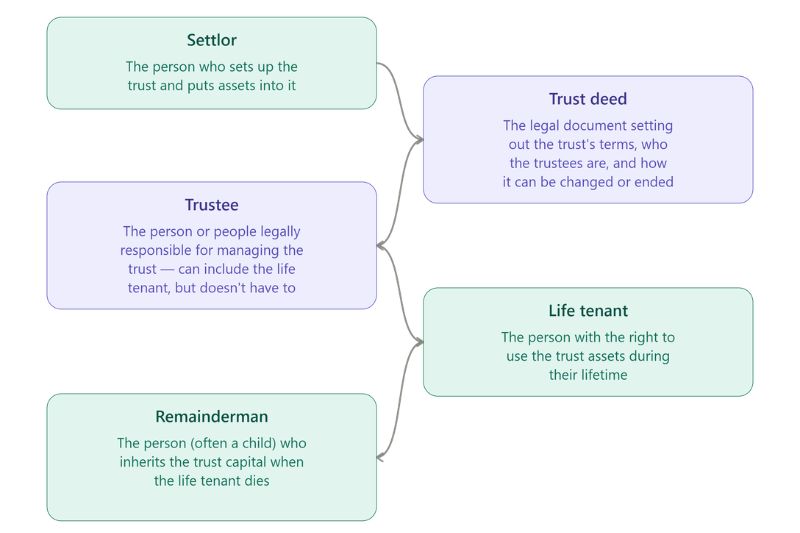
A life interest trust (sometimes called an interest in possession trust) is set up so that one person — the life tenant — has the right to use and benefit from the trust assets during their lifetime, without owning them outright. Most commonly this is a surviving spouse or civil partner, and the asset is usually the family home.
When the life tenant dies, the assets pass to the people named in the trust as the ultimate beneficiaries — the remaindermen. These are typically the children of the person who set up the trust, though they can be any beneficiaries the settlor chooses.
There are two important distinctions:
- The life tenant is not automatically the trustee. The trustees are the people who legally control and administer the trust; the life tenant simply has the right to benefit from it. A surviving spouse can be both, but doesn’t have to be.
- The life tenant generally cannot sell the trust property or give it away without the trustees’ agreement. This is what protects the remaindermen’s eventual inheritance — and it’s also the main practical restriction people find frustrating.
Quick Glossary
Life Interest Trust Rule Updates
A few changes in force this year make this planning more, not less, worthwhile for the right estates:
1. Nil-rate bands are frozen until 2031
The standard nil-rate band stays at £325,000 and the residence nil-rate band at £175,000. As asset values rise and the thresholds don’t, more estates cross the line — a life interest trust can help ring-fence the family home and preserve both spouses’ allowances rather than letting everything land in one estate on second death.
2. Business and agricultural relief changed in 2026
100% relief now applies only to the first £2.5 million of combined qualifying business and agricultural property per person (transferable between spouses, so up to £5 million as a couple), with 50% relief above that. If business or farm assets are part of what you’re planning to put into trust, this changes the sums.
3. Pensions join the estate for IHT from 2027
Unused defined-contribution pensions will count toward your estate from next year, which is prompting many people to revisit their overall estate plan now rather than later — trusts included.
Life Interest Trust Advantages
– Protects the asset while providing for a survivor: The life tenant can use the home or income from the trust for life, while the capital is protected for the next generation — useful where there’s a blended family and you want to provide for a second spouse without disinheriting children from an earlier relationship.
– Preserves the residence nil-rate band: Structured correctly, a life interest trust holding the family home can help both spouses’ residence nil-rate bands be used, rather than the full property value sitting in the survivor’s estate and only one RNRB being available.
– Protects against a survivor’s future decisions: Because the life tenant can’t sell or give away the capital without the trustees’ consent, the eventual inheritance is protected from being spent, gifted away, or lost — including if the survivor later remarries or needs long-term care.
Life Interest Trust Disadvantages
– Restricted control: The life tenant cannot sell, mortgage, or give away the trust property without the trustees’ agreement — even if their own circumstances change.
– Cost and complexity: Setting up and administering a trust involves legal and accountancy fees, and ongoing trustee duties. It’s generally only worthwhile where there’s a meaningful estate or a family home involved — a solicitor or accountant can tell you where that threshold sits for your circumstances.
– No automatic distribution on the life tenant’s death: If the life tenant is a surviving spouse, the remaindermen don’t inherit until that spouse also dies — even where children from an earlier relationship were the intended eventual beneficiaries.
– Income tax on trust income: The life tenant is generally liable for income tax on income arising from the trust, which needs factoring into their personal finances, not treated as free money.
– Delayed access for beneficiaries: Remaindermen typically get nothing until the life tenant dies — which can create family tension, particularly with stepchildren or where beneficiaries have their own financial pressures in the meantime.
Example: How the Numbers Actually Play Out
Take a couple, David and Sarah, who jointly own a family home worth £600,000 plus £100,000 in savings — a £700,000 estate.
1. Without Any Trust Planning
- On David’s death, everything passes to Sarah under spouse exemption (no IHT due at that point).
- But Sarah’s estate now holds the full £700,000.
- On her death, only her own nil-rate band (£325,000) and residence nil-rate band (£175,000) — £500,000 combined — are available, unless David’s unused allowances are formally claimed and transferred.
- If that claim is missed, £200,000 is taxed at 40%, a £80,000 bill.
2. With a Life Interest Trust
- David leaves his half-share of the home (£300,000) into a life interest trust for Sarah, rather than to her outright.
- Sarah retains full use of the home for her lifetime.
- On her death, David’s share passes to their children as remaindermen, using David’s own nil-rate band directly rather than relying on a transfer claim.
- This doesn’t necessarily save more tax than correctly claiming transferable allowances would — but it removes the risk of the claim being missed or mishandled by an executor years later, and it protects David’s share for the children even if Sarah later remarries or needs to fund long-term care.
Which Structure Fits Your Situation?
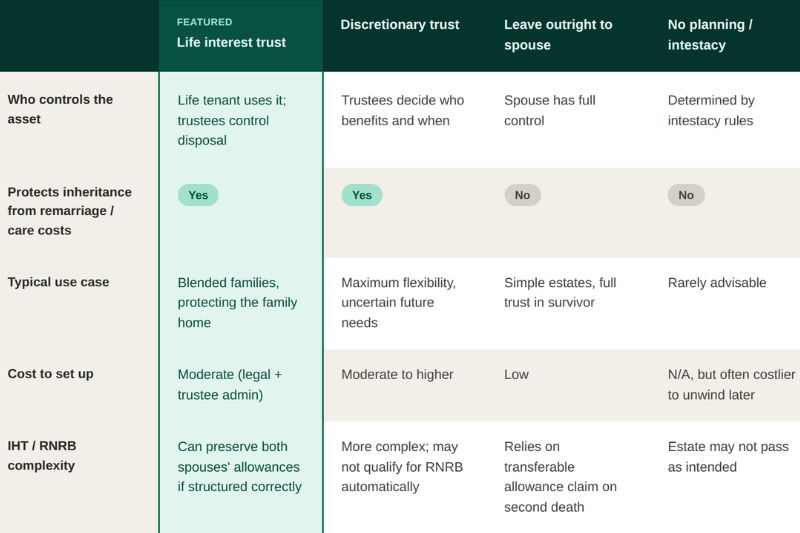
Is a Life Interest Trust Right for You?
Some questions worth working through before deciding:
- Do you have a blended family, or want to provide for a spouse while protecting children’s eventual inheritance?
- Is the family home (or another significant asset) likely to be affected by the frozen nil-rate bands?
- Do you hold business or agricultural assets that the April 2026 relief changes affect?
- Are you comfortable with the ongoing cost and administration of a trust versus simpler options like a straightforward will?
Quick Checklist Before You Decide
Before your first conversation with an accountant or solicitor about a life interest trust, it’s worth having answers to:
What is the current value of the asset(s) you’re considering putting into trust?
Is this a blended family situation, or a straightforward estate?
Do you or your spouse hold business or agricultural assets affected by the April 2026 relief changes?
Has anyone claimed (or will need to claim) a transferable nil-rate band from a previous death in the family?
Who would you want as trustees, and are they willing and able to take this on?
Is there a will already in place, and does it reflect what you’re planning?
Frequently Asked Questions
WHO PAYS TAX ON A LIFE INTEREST TRUST?
The life tenant is generally liable for income tax on income they receive from the trust. Inheritance tax treatment depends on how and when the trust was set up — get this checked, as older trust structures can sometimes disqualify the residence nil-rate band.
CAN A LIFE INTEREST TRUST BE REVOKED?
This depends on how the trust was written. Some are set up as revocable during the settlor’s lifetime; many, once the settlor has died, are fixed and cannot be unwound by the life tenant alone. Check the trust deed rather than assuming either way.
HOW DO I TERMINATE A LIFE INTEREST TRUST?
Termination routes generally include the life tenant’s death (which triggers distribution to the remaindermen), all beneficiaries agreeing and signing a deed, or a court order in disputed cases. Legal advice is essential before attempting this.
HOW DO I CHOOSE TRUSTEES FOR A LIFE INTEREST TRUST?
Look for people who understand your wishes, have the time and capacity to manage the trust properly, and can be trusted to act in the beneficiaries’ interests — this can be family, friends, or a professional trustee such as an accountant or solicitor.
Conclusion
A life interest trust isn’t a tax trick — it’s a way of separating who can use an asset from who eventually owns it, which matters most for blended families and for protecting the family home under frozen nil-rate bands.
It comes with real costs and restrictions, so it’s worth weighing against simpler options before committing. Get the structure right, with the right trustees and a deed that matches your actual wishes, and it can do exactly what it’s meant to: provide for who you want, in the order you want, without leaving it to chance.
We offer a free, no-obligation first consultation to look at your estate, your family situation, and whether a life interest trust — or another structure — makes sense for you.