


Life Interest Trust

Life Interest Trust: Why They Matter More in 2026

Table of Contents

Quick answer: A life interest trust lets you pass on assets — most commonly the family home — while a spouse, partner, or other chosen person keeps the right to use them for their lifetime.

It’s one of the most common tools we discuss with clients doing estate planning, and in 2026 it’s become more relevant, not less: the nil-rate band has been frozen since 2009 and won’t move until at least April 2031, which means more ordinary estates are being pulled into inheritance tax purely because property and investment values have risen while the tax-free threshold hasn’t.

This guide covers how a life interest trust actually works, who the key people are, the real advantages and disadvantages, and what’s changed for 2026 that most articles on this topic haven’t caught up with yet.

What is a Life Interest Trust?

A life interest trust (sometimes called an interest in possession trust) is set up so that one person — the life tenant — has the right to use and benefit from the trust assets during their lifetime, without owning them outright. Most commonly this is a surviving spouse or civil partner, and the asset is usually the family home.

When the life tenant dies, the assets pass to the people named in the trust as the ultimate beneficiaries — the remaindermen. These are typically the children of the person who set up the trust, though they can be any beneficiaries the settlor chooses.

There are two important distinctions:

  1. The life tenant is not automatically the trustee. The trustees are the people who legally control and administer the trust; the life tenant simply has the right to benefit from it. A surviving spouse can be both, but doesn’t have to be.
  2. The life tenant generally cannot sell the trust property or give it away without the trustees’ agreement. This is what protects the remaindermen’s eventual inheritance — and it’s also the main practical restriction people find frustrating.

Quick Glossary
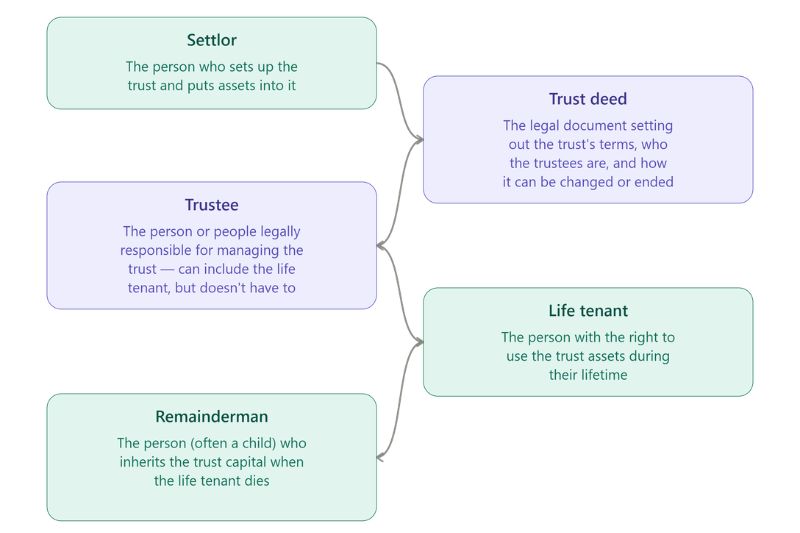
Life Interest Trust

Life Interest Trust Rule Updates

A few changes in force this year make this planning more, not less, worthwhile for the right estates:

1. Nil-rate bands are frozen until 2031

The standard nil-rate band stays at £325,000 and the residence nil-rate band at £175,000. As asset values rise and the thresholds don’t, more estates cross the line — a life interest trust can help ring-fence the family home and preserve both spouses’ allowances rather than letting everything land in one estate on second death.

2. Business and agricultural relief changed in 2026

100% relief now applies only to the first £2.5 million of combined qualifying business and agricultural property per person (transferable between spouses, so up to £5 million as a couple), with 50% relief above that. If business or farm assets are part of what you’re planning to put into trust, this changes the sums.

3. Pensions join the estate for IHT from 2027

Unused defined-contribution pensions will count toward your estate from next year, which is prompting many people to revisit their overall estate plan now rather than later — trusts included.

Life Interest Trust Advantages

– Protects the asset while providing for a survivor: The life tenant can use the home or income from the trust for life, while the capital is protected for the next generation — useful where there’s a blended family and you want to provide for a second spouse without disinheriting children from an earlier relationship.

– Preserves the residence nil-rate band: Structured correctly, a life interest trust holding the family home can help both spouses’ residence nil-rate bands be used, rather than the full property value sitting in the survivor’s estate and only one RNRB being available.

– Protects against a survivor’s future decisions: Because the life tenant can’t sell or give away the capital without the trustees’ consent, the eventual inheritance is protected from being spent, gifted away, or lost — including if the survivor later remarries or needs long-term care.

Life Interest Trust Disadvantages

– Restricted control: The life tenant cannot sell, mortgage, or give away the trust property without the trustees’ agreement — even if their own circumstances change.

– Cost and complexity: Setting up and administering a trust involves legal and accountancy fees, and ongoing trustee duties. It’s generally only worthwhile where there’s a meaningful estate or a family home involved — a solicitor or accountant can tell you where that threshold sits for your circumstances.

– No automatic distribution on the life tenant’s death: If the life tenant is a surviving spouse, the remaindermen don’t inherit until that spouse also dies — even where children from an earlier relationship were the intended eventual beneficiaries.

– Income tax on trust income: The life tenant is generally liable for income tax on income arising from the trust, which needs factoring into their personal finances, not treated as free money.

– Delayed access for beneficiaries: Remaindermen typically get nothing until the life tenant dies — which can create family tension, particularly with stepchildren or where beneficiaries have their own financial pressures in the meantime.

Example: How the Numbers Actually Play Out

Take a couple, David and Sarah, who jointly own a family home worth £600,000 plus £100,000 in savings — a £700,000 estate.

1. Without Any Trust Planning

  • On David’s death, everything passes to Sarah under spouse exemption (no IHT due at that point).
  • But Sarah’s estate now holds the full £700,000.
  • On her death, only her own nil-rate band (£325,000) and residence nil-rate band (£175,000) — £500,000 combined — are available, unless David’s unused allowances are formally claimed and transferred.
  • If that claim is missed, £200,000 is taxed at 40%, a £80,000 bill.

2. With a Life Interest Trust

  • David leaves his half-share of the home (£300,000) into a life interest trust for Sarah, rather than to her outright.
  • Sarah retains full use of the home for her lifetime.
  • On her death, David’s share passes to their children as remaindermen, using David’s own nil-rate band directly rather than relying on a transfer claim.
  • This doesn’t necessarily save more tax than correctly claiming transferable allowances would — but it removes the risk of the claim being missed or mishandled by an executor years later, and it protects David’s share for the children even if Sarah later remarries or needs to fund long-term care.

Which Structure Fits Your Situation?
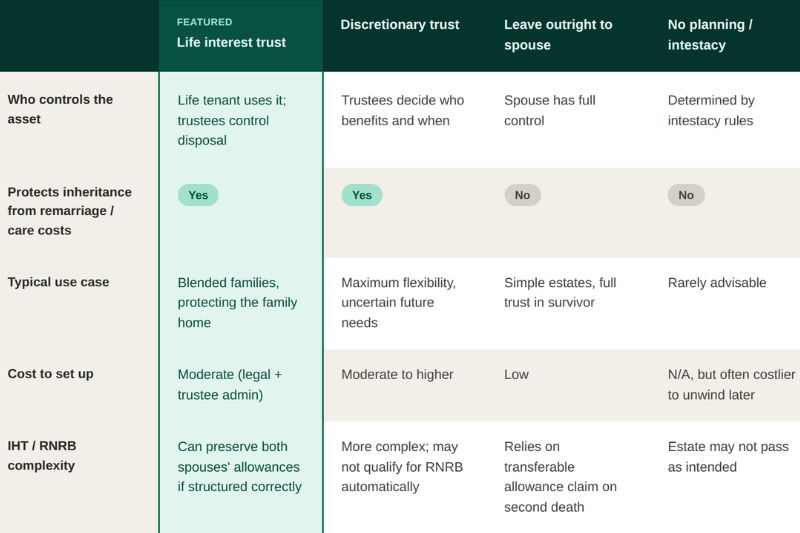
Which structure fits your situation

Is a Life Interest Trust Right for You?

Some questions worth working through before deciding:

  • Do you have a blended family, or want to provide for a spouse while protecting children’s eventual inheritance?
  • Is the family home (or another significant asset) likely to be affected by the frozen nil-rate bands?
  • Do you hold business or agricultural assets that the April 2026 relief changes affect?
  • Are you comfortable with the ongoing cost and administration of a trust versus simpler options like a straightforward will?

Quick Checklist Before You Decide

Before your first conversation with an accountant or solicitor about a life interest trust, it’s worth having answers to:

What is the current value of the asset(s) you’re considering putting into trust?

Is this a blended family situation, or a straightforward estate?

Do you or your spouse hold business or agricultural assets affected by the April 2026 relief changes?

Has anyone claimed (or will need to claim) a transferable nil-rate band from a previous death in the family?

Who would you want as trustees, and are they willing and able to take this on?

Is there a will already in place, and does it reflect what you’re planning?

Frequently Asked Questions

WHO PAYS TAX ON A LIFE INTEREST TRUST?

The life tenant is generally liable for income tax on income they receive from the trust. Inheritance tax treatment depends on how and when the trust was set up — get this checked, as older trust structures can sometimes disqualify the residence nil-rate band.

CAN A LIFE INTEREST TRUST BE REVOKED?

This depends on how the trust was written. Some are set up as revocable during the settlor’s lifetime; many, once the settlor has died, are fixed and cannot be unwound by the life tenant alone. Check the trust deed rather than assuming either way.

HOW DO I TERMINATE A LIFE INTEREST TRUST?

Termination routes generally include the life tenant’s death (which triggers distribution to the remaindermen), all beneficiaries agreeing and signing a deed, or a court order in disputed cases. Legal advice is essential before attempting this.

HOW DO I CHOOSE TRUSTEES FOR A LIFE INTEREST TRUST?

Look for people who understand your wishes, have the time and capacity to manage the trust properly, and can be trusted to act in the beneficiaries’ interests — this can be family, friends, or a professional trustee such as an accountant or solicitor.

Conclusion

A life interest trust isn’t a tax trick — it’s a way of separating who can use an asset from who eventually owns it, which matters most for blended families and for protecting the family home under frozen nil-rate bands.

It comes with real costs and restrictions, so it’s worth weighing against simpler options before committing. Get the structure right, with the right trustees and a deed that matches your actual wishes, and it can do exactly what it’s meant to: provide for who you want, in the order you want, without leaving it to chance.

We offer a free, no-obligation first consultation to look at your estate, your family situation, and whether a life interest trust — or another structure — makes sense for you.


Inheritance tax bill

Best 11 Tips to Reduce Inheritance Tax Bill UK

Table of Contents

Our guide will teach you everything you need to know about inheritance taxes to make sure your plans work out smoothly without any hiccups along the way. 

What is Inheritance Tax?

If you are a UK resident it is important to understand inheritance tax and how to plan for it. It is a tax on the estate of someone who has died, including their property, money, and possessions.

This tax is typically levied on estates above a certain threshold, currently set at £325,000 in the UK.

However, there are ways to reduce the amount of inheritance tax your estate will owe, such as making use of exemptions and reliefs. Consulting with a tax professional can help you create a plan to minimize the impact of inheritance tax on your estate

Inheritance Tax Threshold

The first factor to consider is the nil-rate band which is currently set at £325,000. This means that any assets below this threshold are not subject to inheritance tax. However, for assets exceeding this amount, the tax rate is set at 40% of the total value.

There are also additional considerations that may affect the amount of inheritance tax you have to pay, such as any exemptions or reliefs that may apply, as well as your relationship with the deceased individual. eg. if you are a surviving spouse or civil partner, you may be eligible for a higher nil-rate band.

The inheritance tax threshold rates in the UK are as follows:

  • Nil-rate band: £325,000
  • Residence nil-rate band (direct descendants, such as a child or grandchild): £175,000
  • Total combined nil-rate band for married couples and civil partners: £1 million

What is Nil-Rate Band?

The residence nil rate band (RNRB) is a new inheritance tax allowance that was introduced in April 2017. This allowance allows you to pass on an extra £100,000 tax-free to your heirs.

The nil rate band applies to estates that are left to children or grandchildren, and also it is available to married couples and civil partners who leave their property to each other.

To take advantage of the nil rate band, you must be living in the UK at the time of your death, and it should apply to the main residence. If you are not living in the UK, you may still be able to claim the nil rate band if your estate includes a UK property that is valued at £500,000 or less

11 Tips to Reduce Inheritance Tax Bill

There are several ways to plan ahead and reduce your tax liability in the UK, so it is important to understand how it works.

1. Give Away

Giving away assets and property before you pass. This will help to reduce the value of your estate and as a result, pay less tax amount.

2. Donation

Make charitable donations in your will. Charities are not liable for IHT bills, so by giving money to charities you can reduce your liabilities considerably.

3. Gifts

Consider making gifts to your loved ones during your lifetime. Each year, you can give up to £3,000 worth of gifts without incurring any IHT. You can also give small gifts of up to £250 to as many people as you like, reducing the total value of your estate.

4. Trust

Setting up a trust can help to protect your assets for future generations and can reduce your inheritance tax bill, ensuring part of your estate remains intact. Seek advice from a professional to ensure you set up the right type of trust for your situation.

5. Business Property

Investing in qualifying business property or holding shares in qualifying companies can attract Business Property Relief, which can reduce or eliminate your IHT liability on these assets.

6. Life Insurance

Consider taking out a life insurance policy that will pay out a lump sum on your death, which can help to cover the IHT bill and provide financial support for your loved ones.

7. Non-UK

Leave property to non-UK domiciled individuals. If you own assets overseas, IHT can be avoided by making sure your beneficiaries are not UK citizens.

8. Pass on Your Wealth

If you have a family business, inheritance tax IHT can be reduced by splitting the inheritance between family members.

9. Land

Transfer agricultural land or buildings under the terms of Agricultural Relief (APR).

10. Tax Relief

Make use of tax relief, which may be subject to inheritance tax laws. There are many inheritance tax IHT exemptions and reliefs that your accountant can help you take advantage of.

11. Spend – spend – spend in a tax year

iht bill

Type of Trusts 

Trusts can be a great way to protect your inheritance and ensure that inheritance tax is not payable. There are many different types of trusts available, so it is important to speak with an accountant or estate planner to see which trust would be best for you.

=> Discretionary Trusts

Offers trustees the flexibility to decide how and when to distribute the trust’s assets among the beneficiaries. It’s often used for estate planning to protect assets.

=> Family Trusts

Are established to manage and protect family assets, ensuring they are preserved for future generations. These trusts can offer tax benefits and help in the efficient transfer of wealth within a family.

=> Fixed Trusts

The beneficiaries and their entitlements are predetermined and specified in the trust deed. Provides certainty and clarity regarding who receives what portion of the trust’s assets.

=> Offshore Trusts

Created in jurisdictions with favourable tax laws, often to achieve tax efficiency and asset protection. Used by individuals and businesses to manage wealth internationally.

=> Charitable Trusts

Providing tax advantages to the donor. The assets are used for public benefit, often supporting causes like education, healthcare, and poverty alleviation.

Common Mistakes Made with IHT Bill

1.) Not filing a return at all – this is the most common mistake and can lead to penalties and interest.

2.) Filing a return that is inaccurate or incomplete – this can also lead to penalties and interest.

3.) Not paying inheritance tax when it is due – if you do not pay on time, you may face significant penalties.

4.) Paying IHT when it is not due – sometimes people mistakenly think they have to pay inheritance tax when they do not have to.

5.) Failing to take into account available exemptions and allowances – this can result in you paying more inheritance tax than necessary.

6.) Not keeping records up-to-date.

7.) Not taking into account changes in your personal circumstances e.g. If you get married, divorced, or have children, it is important to update your direct descendants, who are part of your estate.

Benefits of Married Couple

=> The main benefit for spouses is that it allows the surviving partner to inherit the estate tax-free, even if the estate exceeds the nil rate band. This means that they will not have to pay any tax on the assets and property that they inherit from their deceased spouse or partner.

=> Another benefit of inheritance tax IHT is that it helps to protect the inheritance of the surviving spouse or partner. This can be important if the surviving registered civil partner needs money to live on after their partner has died.

FAQ – Pay Inheritance Tax

=> HOW TO PREPARE FOR INHERITANCE TAX?

  1. A financial adviser can provide valuable guidance on how to prepare for inheritance tax, ensuring the unused allowances are considered. They can assist in assessing your current financial situation and offer tailored advice on minimizing tax liabilities.
  2. Understanding the rules around inheritance tax on gifts is crucial. Knowing how and when to gift assets can significantly reduce the amount of tax your loved ones may have to pay in the future.
  3. Seeking legal advice is recommended to ensure your estate planning aligns with inheritance tax laws. Consulting with a solicitor can help you create a tax-efficient will that maximizes the inheritance left to your beneficiaries and helps you make a plan for probate.
  4. Proactive planning helps mitigate the effects of inheritance tax. By taking steps to organize your assets and investments, you can minimize the tax burden on your estate and ensure your beneficiaries receive the maximum benefit from your legacy.

=> HOW TO PAY INHERITANCE TAX? 

The IHT is usually paid by the executor of the deceased person’s estate. Complete and submit an inheritance tax return within 12 months of the death, as the estate may be subject to inheritance tax. Once the inheritance tax has been paid, the executor can apply for a clearance certificate from HMRC, facilitating the probate process.

Financial advice should always be sought when dealing with inheritance tax to pay or before making any payments to HMRC. 

=> CAN I LEAVE A HOUSE IN A TRUST TO AVOID AN INHERITANCE TAX BILL?

Trusts can be a great way to protect your inheritance and ensure that inheritance tax is not payable. When you put your house or other assets in a trust, the property is transferred to a trustee who will be responsible for managing it on your behalf.

As the trustee is not the owner of the property, they will not be liable for inheritance tax purposes. This can be a great way to protect your family home from estate taxes and ensure that it goes to your heirs without any additional costs.

=> HOW TO PROTECT YOUR ESTATE?

One of the simplest and most effective ways is to plan ahead. Another way is to make sure that you are aware of all the exemptions and allowances that are available, which may be subject to inheritance tax. Many different types of properties are exempt from inheritance tax, so it is important to understand what these are.

Conclusion – Planning Advice

Inheritance tax can be complex, comes down to individual circumstances and may require the help of an accountant to understand how it works, especially if the total value of your estate exceeds the nil rate band.

It is very important to make plans ahead for your estate value so that you are not faced with unexpected taxes or penalties because you did not know about them before they came into effect.

There are many ways to protect your family wealth and business assets, but only if you plan in advance by understanding what IHT exemptions exist and how best to use them wisely.

If all this sounds overwhelming, let us know – our team of experts at MH Services will gladly assist with any questions related to taxation services, including those about inheritance tax your loved ones may need to consider.