

If you run a limited company and someone has mentioned the word “audit”, this guide tells you what it actually involves, whether you need one, what it costs, and how to get through it without losing a fortnight. It is written for business owners, not auditors, and it reflects the UK rules that changed on 6 April 2025.
What is a company audit?
A company audit is an independent examination of your financial statements by a registered auditor, who then gives a written opinion on whether those statements show a “true and fair view” of the business. In the UK, this is called a statutory audit, because it is required by the Companies Act 2006 for companies above a certain size.
An audit is not a check of every invoice. The auditor plans their work around risk, tests samples of transactions and balances, examines the systems that produce your numbers, and forms an opinion. The output is the auditor’s report, which sits inside your annual accounts and is filed at Companies House alongside them.
The auditor is working for your shareholders, not for you as a director. That distinction matters: their job is to give an independent view, which is exactly why lenders, investors and buyers place weight on it.
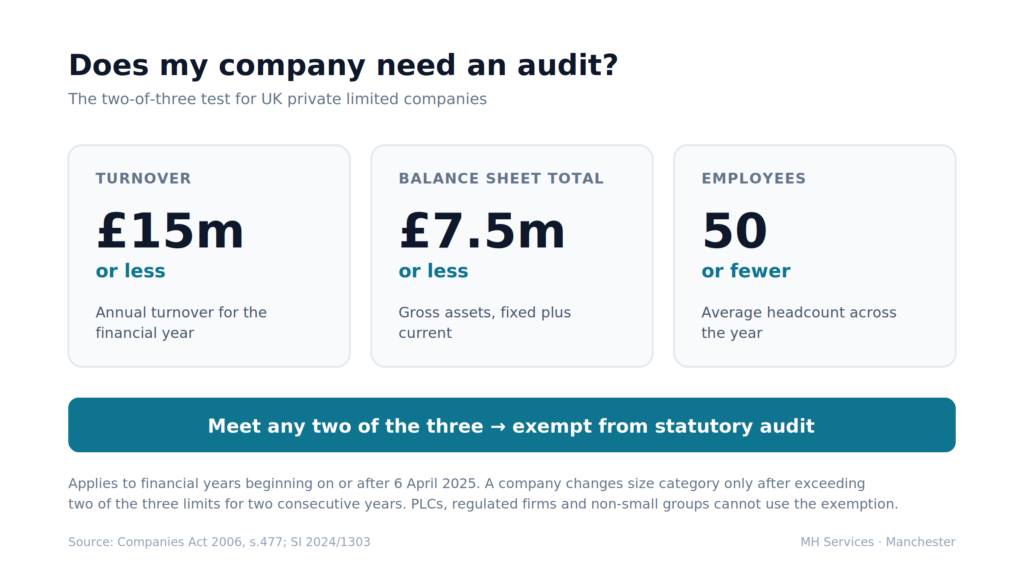
Most UK small companies do not. For financial years beginning on or after 6 April 2025, a private limited company is exempt from a statutory audit if it meets at least two of these three tests:
- Annual turnover of £15 million or less
- Balance sheet total (gross assets) of £7.5 million or less
- An average of 50 or fewer employees
These are the “small company” limits set by the Companies (Accounts and Reports) (Amendment and Transitional Provision) Regulations 2024. They replaced the previous figures of £10.2 million turnover and £5.1 million balance sheet, which had stood since 2016. The employee limit did not change.
Three details catch people out:
- The two-year rule. You do not lose exemption the first year you cross the limits. A company only changes size category when it exceeds two of the three tests for two consecutive financial years. Equally, a company that has been having audits does not become exempt until it has met the small-company tests for two consecutive years.
- The thresholds depend on when your financial year started. A company with a year running 1 January to 31 December 2025 is still measured against the old limits, because that year began before 6 April 2025. The new limits first apply to the year beginning 1 January 2026. A company with a 31 March year end gets the new limits from the year ending 31 March 2026.
- Some companies need an audit regardless of size. You cannot use the small-company exemption if the company is:
- A public limited company (PLC)
- A bank, insurer, e-money issuer or certain other FCA-regulated firms
- Part of a group that, taken as a whole, is not small (the tests are applied to the group, not just your company)
- Required to have an audit by its own articles of association
- Asked to have one by shareholders holding 10% or more of the shares, by written notice at least one month before the year end
If you use the exemption, your balance sheet must carry a statement confirming the company was entitled to it. Your accountant will include this.

Company A — a precision engineering firm in Trafford Park. Turnover £11 million, balance sheet total £6 million, 38 employees. Under the old limits it exceeded both turnover (£10.2m) and balance sheet (£5.1m), so it needed an audit. Under the new limits it meets all three tests. Once it has met them for two consecutive years, it can claim exemption and stop having a statutory audit.
Company B — a logistics business in Salford. Turnover £16 million, balance sheet total £7 million, 45 employees. It exceeds the turnover limit but meets the other two. Because it only needs to pass two of three, it still qualifies as small and is exempt.
Company C — a growing software company in the city centre. Turnover £16 million, balance sheet total £8 million, 45 employees. It exceeds two of the three tests. If it does so for two consecutive years, it becomes a medium-sized company and a statutory audit is required.
The lesson from Company C: if you are close to two of the limits, plan for it. An audit takes weeks, not days, and your first one is always the hardest.
The five stages of an audit process
An audit follows a set path. Knowing what happens at each stage — and what the auditor will ask you for — removes most of the stress.
1. Planning
The auditor gets to know your business, your industry, your systems and where the risks sit. They set a materiality level (the size of error that would matter to a reader of the accounts) and decide which areas need the most attention. Expect a planning meeting and a list of information requests, usually a few weeks before the year end or shortly after it.
What they’ll ask for: last year’s accounts, management accounts, an organisation chart, a description of how sales, purchases and payroll are processed, and details of any unusual events during the year.
2. Fieldwork
This is the main body of the audit. The auditor tests transactions and balances: confirming bank balances directly with your bank, sampling sales invoices back to contracts and cash received, checking that stock exists and is valued correctly, agreeing fixed assets to invoices, and reviewing debtors for anything unlikely to be paid.
For a single-entity company with turnover between £1 million and £15 million, fieldwork typically takes five to fifteen working days, on site or remotely.
What they’ll ask for: bank statements, sales and purchase ledgers, aged debtor and creditor lists, fixed asset register, stock records, payroll reports, VAT returns, loan agreements, leases and board minutes.
3. Analysis and evaluation
The auditor pulls the evidence together, reviews the accounting judgements you have made (depreciation rates, bad debt provisions, revenue recognition, going concern), and decides whether any adjustments are needed. This is where most discussion happens between you and the audit team.
4. Reporting
The auditor issues their report. There are four possible opinions:
- Unmodified (clean) — the accounts give a true and fair view. This is what almost every well-run company receives.
- Qualified — the accounts are fine except for one specific matter, which the report describes.
- Adverse — the accounts are materially misstated. Rare and serious.
- Disclaimer — the auditor could not get enough evidence to form an opinion at all.
Alongside the formal report, most auditors provide a management letter setting out weaknesses they noticed in your controls and how to fix them. This is often the most useful document the audit produces.
5. Follow-up
You act on the management letter, the accounts are approved by the board and filed at Companies House (within nine months of the year end for a private company), and the auditor carries the findings forward into next year’s planning. Fix the points raised; the same weaknesses appearing two years running does not look good.
Total elapsed time: usually eight to twelve weeks from planning to signed report, driven mostly by how quickly you provide information.
What types of audit are there?
The word “audit” covers several different things. The one most business owners mean is the statutory financial audit, but it helps to know the others.

- Statutory (financial) audit. The Companies Act audit of your annual accounts by a registered auditor, described above. Mandatory above the size thresholds.
- Internal audit. A review carried out by people inside the business (or an outsourced team reporting to management) to test whether controls and processes are working. It is not independent in the statutory sense and does not produce an opinion for Companies House, but it is invaluable for catching problems early. Larger companies run an internal audit function; smaller ones often do a lighter version through their finance manager or external accountant.
- Compliance audit. Checks whether the business is following specific laws, regulations or contract terms — for example a grant audit, a pension scheme audit, or a check on FCA conduct rules.
- Performance (or operational) audit. Looks at whether a process is efficient and effective rather than whether the numbers are right. Useful before a sale, an expansion, or a systems change.
Internal vs external audit — the real difference
The difference is independence. An external auditor is a registered firm with no employment relationship with the company, and their opinion carries legal weight. An internal auditor works for management, focuses on whichever areas management chooses, and their findings are for internal use.
Internal audit is cheaper and faster and can be pointed at any weak spot. Its limitation is exactly that closeness: it cannot give outsiders the assurance that an independent opinion gives. Most growing companies benefit from both — internal checks through the year, external audit at the year end.
Who can carry out an audit in the UK?
Only a registered auditor can sign a statutory audit report in the UK. This is a firm (or individual) registered with one of the Recognised Supervisory Bodies — the ICAEW, ACCA, ICAS or Chartered Accountants Ireland — and subject to their inspection regime. The report is signed by a named Senior Statutory Auditor on behalf of the firm.
This matters because the term “accountant” is not protected. Many excellent accountancy practices do not hold audit registration, because most of their clients are exempt and the registration involves significant regulatory cost.
If your accountant is not a registered auditor, they can prepare your accounts and tax returns as normal, but a separate registered firm will need to carry out the audit. The two often work together, and a well-organised accountant makes the auditor’s job — and your fee — smaller.
When choosing an auditor, ask: Are you audit-registered, and with which body? Who will be the Senior Statutory Auditor on my engagement? Have you audited businesses in my sector? What is included in the fee, and what triggers extra charges?
How to prepare for your first audit?
The single biggest factor in how long an audit takes, and what it costs, is how ready you are. A checklist:
Before the year end
- Agree the timetable and information list with the auditor.
- Reconcile every bank account and clear old unreconciled items.
- Chase old debtors and decide which balances need a provision.
- Count stock at the year end (the auditor may want to attend).
- Make sure fixed asset additions and disposals are recorded, with invoices filed.
- Get loan statements, lease agreements and any legal correspondence together.
After the year end
- Produce a full trial balance and draft accounts as early as you can.
- Prepare schedules that support each significant balance: debtors, creditors, accruals, prepayments, fixed assets, stock.
- Have the board minutes and shareholder register up to date.
- Nominate one person as the auditor’s point of contact.
During the audit
- Answer requests promptly. Every day of delay is a day of fee.
- Keep a shared log of outstanding items.
- Be open about judgement calls. Auditors deal far better with a clearly explained estimate than with one they have to reverse-engineer.
A company that walks in with reconciled ledgers, supporting schedules and a named contact will typically have a shorter, cheaper and calmer audit than one that hands over a shoebox.
What are internal controls?
Internal controls are the processes a company puts in place to make sure its financial information is accurate, its assets are protected, and its people follow the rules. Auditors test them because strong controls mean the numbers can be trusted, which reduces the amount of detailed testing they need to do.
The framework almost every auditor uses (COSO) describes five components. In a small business they look like this:

Good controls are not about bureaucracy. In a small company they often come down to one principle: no single person should be able to raise, approve, pay and record a transaction on their own.
Should I have an audit even if I’m exempt?
Sometimes, yes. A voluntary audit is worth considering if:
- A lender or investor wants one. Bank covenants, private equity investors and grant bodies often require audited accounts whatever the company’s size.
- You are planning to sell the business. Buyers pay more, and negotiate less, for numbers that have been independently verified for the last two or three years.
- You have external shareholders who are not involved day to day. An audit gives them comfort and reduces disputes.
- You want to tighten up. The management letter from a first audit frequently identifies weaknesses the owner never knew existed.
- You are close to the thresholds. Starting a year early means your first mandatory audit is not also your first ever audit.
If none of these apply, the money is often better spent on stronger management accounts and a good accountant.
How much does an audit cost?
For a straightforward single-entity UK company with turnover between £1 million and £15 million, statutory audit fees in 2026 typically fall between £6,000 and £12,000 plus VAT.
Group structures, regulated sectors and overseas operations move that towards £15,000 to £35,000. Fees across the profession have risen since 2024 as regulatory inspection has tightened.
MH Services audits for small and medium-sized companies in Greater Manchester start from £1,000 plus VAT.
Four things drive the price:
- Turnover and transaction volume — more transactions, more testing.
- Complexity — group companies, foreign currency, stock, long-term contracts and revenue recognition judgements all add work.
- Sector — regulated or specialised sectors need auditors with the right expertise.
- Your preparation — a clean, reconciled set of records can knock days off the fieldwork.
Get the fee basis in writing, including what counts as “additional work” and how it will be charged.
Frequently asked questions
WHAT IS THE AUDIT THRESHOLD IN THE UK FOR 2026?
A private company is exempt from audit if it meets at least two of: turnover of £15 million or less, balance sheet total of £7.5 million or less, and 50 or fewer employees. These apply to financial years beginning on or after 6 April 2025.
HOW LONG DOES A COMPANY AUDIT TAKE?
Usually eight to twelve weeks from planning to signed report for a small or medium company, with five to fifteen days of fieldwork. Well-prepared companies sit at the shorter end.
CAN MY ACCOUNTANT DO MY AUDIT?
Only if they are a registered auditor. Many accountancy practices are not, in which case a separate registered firm carries out the audit while your accountant continues to prepare the accounts.
WHAT IS THE DIFFERENCE BETWEEN AN AUDIT AND A REVIEW?
An audit gives a positive opinion that the accounts show a true and fair view, based on detailed testing. A review is a lighter, limited-assurance engagement that only reports whether anything came to the accountant’s attention suggesting a problem. Reviews are cheaper but carry much less weight.
WHAT HAPPENS IF MY COMPANY NEEDS AN AUDIT AND DOESN’T HAVE ONE?
The accounts will not be compliant with the Companies Act. Companies House can reject them, the directors can face penalties, and lenders or shareholders may have grounds to challenge the accounts. If you think you may have crossed the thresholds, speak to an auditor early.
DO I NEED AN AUDIT IF MY COMPANY IS DORMANT?
No. Dormant companies are exempt from audit provided they meet the dormancy conditions and file dormant accounts.
IS AN AUDIT THE SAME AS AN HMRC INVESTIGATION?
No. An audit is an independent review of your accounts for shareholders. An HMRC enquiry is a tax authority checking your tax return. They are separate processes, though good records help with both.