
UK business audit process

Audit Process for UK Business Owners | Thresholds, Stages & Cost

Table of Contents

If you run a limited company and someone has mentioned the word “audit”, this guide tells you what it actually involves, whether you need one, what it costs, and how to get through it without losing a fortnight. It is written for business owners, not auditors, and it reflects the UK rules that changed on 6 April 2025.

What is a company audit?

A company audit is an independent examination of your financial statements by a registered auditor, who then gives a written opinion on whether those statements show a “true and fair view” of the business. In the UK, this is called a statutory audit, because it is required by the Companies Act 2006 for companies above a certain size.

An audit is not a check of every invoice. The auditor plans their work around risk, tests samples of transactions and balances, examines the systems that produce your numbers, and forms an opinion. The output is the auditor’s report, which sits inside your annual accounts and is filed at Companies House alongside them.

The auditor is working for your shareholders, not for you as a director. That distinction matters: their job is to give an independent view, which is exactly why lenders, investors and buyers place weight on it.
Does my company need an audit?

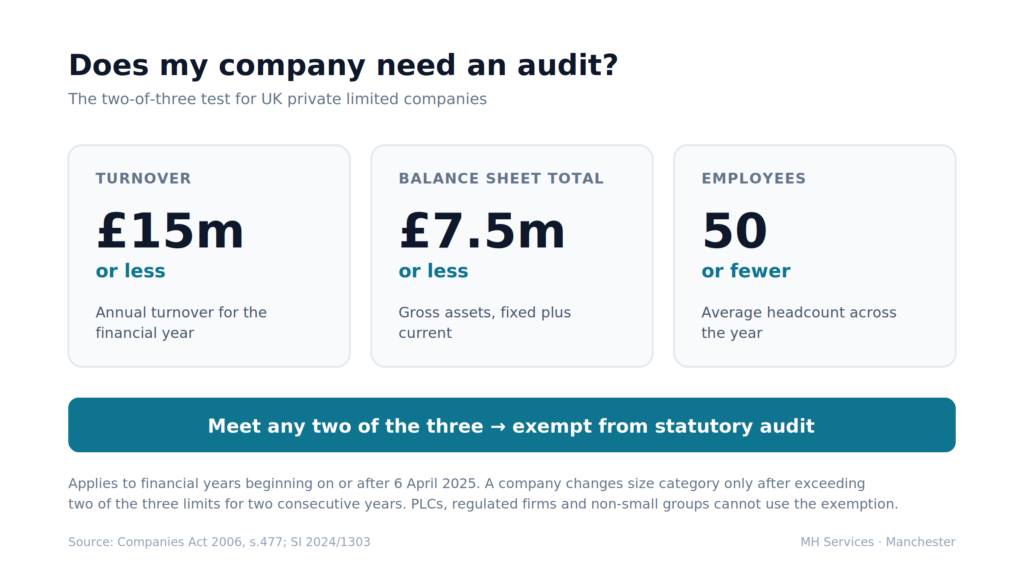
Most UK small companies do not. For financial years beginning on or after 6 April 2025, a private limited company is exempt from a statutory audit if it meets at least two of these three tests:

  • Annual turnover of £15 million or less
  • Balance sheet total (gross assets) of £7.5 million or less
  • An average of 50 or fewer employees

These are the “small company” limits set by the Companies (Accounts and Reports) (Amendment and Transitional Provision) Regulations 2024. They replaced the previous figures of £10.2 million turnover and £5.1 million balance sheet, which had stood since 2016. The employee limit did not change.

Three details catch people out:

  1. The two-year rule. You do not lose exemption the first year you cross the limits. A company only changes size category when it exceeds two of the three tests for two consecutive financial years. Equally, a company that has been having audits does not become exempt until it has met the small-company tests for two consecutive years.
  2. The thresholds depend on when your financial year started. A company with a year running 1 January to 31 December 2025 is still measured against the old limits, because that year began before 6 April 2025. The new limits first apply to the year beginning 1 January 2026. A company with a 31 March year end gets the new limits from the year ending 31 March 2026.
  3. Some companies need an audit regardless of size. You cannot use the small-company exemption if the company is:
  • A public limited company (PLC)
  • A bank, insurer, e-money issuer or certain other FCA-regulated firms
  • Part of a group that, taken as a whole, is not small (the tests are applied to the group, not just your company)
  • Required to have an audit by its own articles of association
  • Asked to have one by shareholders holding 10% or more of the shares, by written notice at least one month before the year end

If you use the exemption, your balance sheet must carry a statement confirming the company was entitled to it. Your accountant will include this.

Worked example: three Manchester companies

Company A — a precision engineering firm in Trafford Park. Turnover £11 million, balance sheet total £6 million, 38 employees. Under the old limits it exceeded both turnover (£10.2m) and balance sheet (£5.1m), so it needed an audit. Under the new limits it meets all three tests. Once it has met them for two consecutive years, it can claim exemption and stop having a statutory audit.

Company B — a logistics business in Salford. Turnover £16 million, balance sheet total £7 million, 45 employees. It exceeds the turnover limit but meets the other two. Because it only needs to pass two of three, it still qualifies as small and is exempt.

Company C — a growing software company in the city centre. Turnover £16 million, balance sheet total £8 million, 45 employees. It exceeds two of the three tests. If it does so for two consecutive years, it becomes a medium-sized company and a statutory audit is required.

The lesson from Company C: if you are close to two of the limits, plan for it. An audit takes weeks, not days, and your first one is always the hardest.

The five stages of an audit process

An audit follows a set path. Knowing what happens at each stage — and what the auditor will ask you for — removes most of the stress.

1. Planning

The auditor gets to know your business, your industry, your systems and where the risks sit. They set a materiality level (the size of error that would matter to a reader of the accounts) and decide which areas need the most attention. Expect a planning meeting and a list of information requests, usually a few weeks before the year end or shortly after it.

What they’ll ask for: last year’s accounts, management accounts, an organisation chart, a description of how sales, purchases and payroll are processed, and details of any unusual events during the year.

2. Fieldwork

This is the main body of the audit. The auditor tests transactions and balances: confirming bank balances directly with your bank, sampling sales invoices back to contracts and cash received, checking that stock exists and is valued correctly, agreeing fixed assets to invoices, and reviewing debtors for anything unlikely to be paid. 

For a single-entity company with turnover between £1 million and £15 million, fieldwork typically takes five to fifteen working days, on site or remotely.

What they’ll ask for: bank statements, sales and purchase ledgers, aged debtor and creditor lists, fixed asset register, stock records, payroll reports, VAT returns, loan agreements, leases and board minutes.

3. Analysis and evaluation

The auditor pulls the evidence together, reviews the accounting judgements you have made (depreciation rates, bad debt provisions, revenue recognition, going concern), and decides whether any adjustments are needed. This is where most discussion happens between you and the audit team.

4. Reporting

The auditor issues their report. There are four possible opinions:

  • Unmodified (clean) — the accounts give a true and fair view. This is what almost every well-run company receives.
  • Qualified — the accounts are fine except for one specific matter, which the report describes.
  • Adverse — the accounts are materially misstated. Rare and serious.
  • Disclaimer — the auditor could not get enough evidence to form an opinion at all.

Alongside the formal report, most auditors provide a management letter setting out weaknesses they noticed in your controls and how to fix them. This is often the most useful document the audit produces.

5. Follow-up

You act on the management letter, the accounts are approved by the board and filed at Companies House (within nine months of the year end for a private company), and the auditor carries the findings forward into next year’s planning. Fix the points raised; the same weaknesses appearing two years running does not look good.

Total elapsed time: usually eight to twelve weeks from planning to signed report, driven mostly by how quickly you provide information.

What types of audit are there?

The word “audit” covers several different things. The one most business owners mean is the statutory financial audit, but it helps to know the others.

Four types of audit compared: statutory audit (mandatory above thresholds, for shareholders and lenders), internal audit (voluntary, in-house, for management), compliance audit (rules-based, for regulators and funders), performance audit (efficiency-focused, for owners planning a change).

  • Statutory (financial) audit. The Companies Act audit of your annual accounts by a registered auditor, described above. Mandatory above the size thresholds.
  • Internal audit. A review carried out by people inside the business (or an outsourced team reporting to management) to test whether controls and processes are working. It is not independent in the statutory sense and does not produce an opinion for Companies House, but it is invaluable for catching problems early. Larger companies run an internal audit function; smaller ones often do a lighter version through their finance manager or external accountant.
  • Compliance audit. Checks whether the business is following specific laws, regulations or contract terms — for example a grant audit, a pension scheme audit, or a check on FCA conduct rules.
  • Performance (or operational) audit. Looks at whether a process is efficient and effective rather than whether the numbers are right. Useful before a sale, an expansion, or a systems change.

Internal vs external audit — the real difference

The difference is independence. An external auditor is a registered firm with no employment relationship with the company, and their opinion carries legal weight. An internal auditor works for management, focuses on whichever areas management chooses, and their findings are for internal use.

Internal audit is cheaper and faster and can be pointed at any weak spot. Its limitation is exactly that closeness: it cannot give outsiders the assurance that an independent opinion gives. Most growing companies benefit from both — internal checks through the year, external audit at the year end.

Who can carry out an audit in the UK?

Only a registered auditor can sign a statutory audit report in the UK. This is a firm (or individual) registered with one of the Recognised Supervisory Bodies — the ICAEW, ACCA, ICAS or Chartered Accountants Ireland — and subject to their inspection regime. The report is signed by a named Senior Statutory Auditor on behalf of the firm.

This matters because the term “accountant” is not protected. Many excellent accountancy practices do not hold audit registration, because most of their clients are exempt and the registration involves significant regulatory cost. 

If your accountant is not a registered auditor, they can prepare your accounts and tax returns as normal, but a separate registered firm will need to carry out the audit. The two often work together, and a well-organised accountant makes the auditor’s job — and your fee — smaller.

When choosing an auditor, ask: Are you audit-registered, and with which body? Who will be the Senior Statutory Auditor on my engagement? Have you audited businesses in my sector? What is included in the fee, and what triggers extra charges?

How to prepare for your first audit?

The single biggest factor in how long an audit takes, and what it costs, is how ready you are. A checklist:

Before the year end

  • Agree the timetable and information list with the auditor.
  • Reconcile every bank account and clear old unreconciled items.
  • Chase old debtors and decide which balances need a provision.
  • Count stock at the year end (the auditor may want to attend).
  • Make sure fixed asset additions and disposals are recorded, with invoices filed.
  • Get loan statements, lease agreements and any legal correspondence together.

After the year end

  • Produce a full trial balance and draft accounts as early as you can.
  • Prepare schedules that support each significant balance: debtors, creditors, accruals, prepayments, fixed assets, stock.
  • Have the board minutes and shareholder register up to date.
  • Nominate one person as the auditor’s point of contact.

During the audit

  • Answer requests promptly. Every day of delay is a day of fee.
  • Keep a shared log of outstanding items.
  • Be open about judgement calls. Auditors deal far better with a clearly explained estimate than with one they have to reverse-engineer.

A company that walks in with reconciled ledgers, supporting schedules and a named contact will typically have a shorter, cheaper and calmer audit than one that hands over a shoebox.

What are internal controls?

Internal controls are the processes a company puts in place to make sure its financial information is accurate, its assets are protected, and its people follow the rules. Auditors test them because strong controls mean the numbers can be trusted, which reduces the amount of detailed testing they need to do.

The framework almost every auditor uses (COSO) describes five components. In a small business they look like this:

The five components of internal control (COSO) applied to a small business: control environment, risk assessment, control activities, information and communication, and monitoring. Principle: no single person should raise, approve, pay and record a transaction alone.

Good controls are not about bureaucracy. In a small company they often come down to one principle: no single person should be able to raise, approve, pay and record a transaction on their own.

Should I have an audit even if I’m exempt?

Sometimes, yes. A voluntary audit is worth considering if:

  • A lender or investor wants one. Bank covenants, private equity investors and grant bodies often require audited accounts whatever the company’s size.
  • You are planning to sell the business. Buyers pay more, and negotiate less, for numbers that have been independently verified for the last two or three years.
  • You have external shareholders who are not involved day to day. An audit gives them comfort and reduces disputes.
  • You want to tighten up. The management letter from a first audit frequently identifies weaknesses the owner never knew existed.
  • You are close to the thresholds. Starting a year early means your first mandatory audit is not also your first ever audit.

If none of these apply, the money is often better spent on stronger management accounts and a good accountant.

How much does an audit cost?

For a straightforward single-entity UK company with turnover between £1 million and £15 million, statutory audit fees in 2026 typically fall between £6,000 and £12,000 plus VAT.

Group structures, regulated sectors and overseas operations move that towards £15,000 to £35,000. Fees across the profession have risen since 2024 as regulatory inspection has tightened.

MH Services audits for small and medium-sized companies in Greater Manchester start from £1,000 plus VAT.

Four things drive the price:

  • Turnover and transaction volume — more transactions, more testing.
  • Complexity — group companies, foreign currency, stock, long-term contracts and revenue recognition judgements all add work.
  • Sector — regulated or specialised sectors need auditors with the right expertise.
  • Your preparation — a clean, reconciled set of records can knock days off the fieldwork.

Get the fee basis in writing, including what counts as “additional work” and how it will be charged.

Frequently asked questions

WHAT IS THE AUDIT THRESHOLD IN THE UK FOR 2026? 

A private company is exempt from audit if it meets at least two of: turnover of £15 million or less, balance sheet total of £7.5 million or less, and 50 or fewer employees. These apply to financial years beginning on or after 6 April 2025.

HOW LONG DOES A COMPANY AUDIT TAKE? 

Usually eight to twelve weeks from planning to signed report for a small or medium company, with five to fifteen days of fieldwork. Well-prepared companies sit at the shorter end.

CAN MY ACCOUNTANT DO MY AUDIT? 

Only if they are a registered auditor. Many accountancy practices are not, in which case a separate registered firm carries out the audit while your accountant continues to prepare the accounts.

WHAT IS THE DIFFERENCE BETWEEN AN AUDIT AND A REVIEW? 

An audit gives a positive opinion that the accounts show a true and fair view, based on detailed testing. A review is a lighter, limited-assurance engagement that only reports whether anything came to the accountant’s attention suggesting a problem. Reviews are cheaper but carry much less weight.

WHAT HAPPENS IF MY COMPANY NEEDS AN AUDIT AND DOESN’T HAVE ONE? 

The accounts will not be compliant with the Companies Act. Companies House can reject them, the directors can face penalties, and lenders or shareholders may have grounds to challenge the accounts. If you think you may have crossed the thresholds, speak to an auditor early.

DO I NEED AN AUDIT IF MY COMPANY IS DORMANT? 

No. Dormant companies are exempt from audit provided they meet the dormancy conditions and file dormant accounts.

IS AN AUDIT THE SAME AS AN HMRC INVESTIGATION?

No. An audit is an independent review of your accounts for shareholders. An HMRC enquiry is a tax authority checking your tax return. They are separate processes, though good records help with both.

paye reference number

PAYE Reference Number vs UTR | Easy UK Tax System Guide

Table of Contents

Navigating the UK tax system can feel overwhelming, especially when juggling multiple terms and identifiers. Among the most common sources of confusion are the PAYE Reference Number and the Unique Taxpayer Reference (UTR).

While both are crucial, they serve entirely different purposes and apply to different scenarios. This guide breaks down what each identifier means, its roles, and how it impacts individuals and businesses in the UK, including VAT registration numbers.

What Is a PAYE Reference Number?

A PAYE (Pay As You Earn) Reference Number is a unique code issued to employers by HM Revenue and Customs (HMRC). It’s essential for managing payroll and ensuring that employees’ tax and National Insurance contributions are correctly deducted and reported on their payslip.

Who Needs a PAYE Tax Reference Number?

  • Employers: If you’re running a business and employing staff, you’ll need a PAYE Reference Number to register as an employer with HMRC.
  • Employees: While employees don’t need to apply for this number, it’s useful to understand it since it appears on payslips and tax documents.

Format of a PAYE Reference Number

A PAYE Reference Number typically consists of three parts:

  1. Tax Office Number: A three-digit code identifying your HMRC office.
  2. Employer Reference: A unique identifier specific to your business.
  3. Suffix: In some cases, there might be additional characters for sub-divisions, such as letters and numbers.

eg. PAYE Reference Number might look like this, a combination of letters and numbers: 123/AB45678

Where to Find Your PAYE Reference Number?

  • Employer’s welcome pack from HMRC after registration
  • Correspondence from HMRC, such as tax notifications
  • Payslips and P60 forms for employees

What Is a Unique Taxpayer Reference (UTR)?

A UTR is a 10-digit number assigned to individuals and businesses when they register for self-assessment with HMRC. It’s a key identifier for those who need to report income, profits, and expenses outside the PAYE system.

Who Needs a UTR Number?

  • Self-employed individuals: Freelancers, sole traders, and contractors.
  • Company directors: Required for filing personal tax returns.
  • Landlords: Those earning rental income above the annual allowance.
  • Partnerships: Each partner and the partnership it self will have separate UTRs.

Format of a UTR

A UTR is always a 10-digit number, sometimes followed by a letter, like an identification number for tax purposes: 1234567890K

Where to Find Your UTR

  • HMRC correspondence, such as the registration confirmation letter
  • Your online personal tax account with HMRC.
  • Previous self-assessment tax returns

utr reference

PAYE vs UTR Key Differences

Although both numbers are issued by HMRC, their roles and applications differ significantly. 

PAYE Reference Number

  • Purpose: Payroll management and employee tax reporting
  • Who uses it: Employers and HMRC must ensure that all tax records are accurate and up to date.
  • Format: Combination of digits and letters
  • Where to find: HMRC employer documents

Unique Tax Reference Number

  • Purpose: Self-assessment and income tax filing
  • Who uses it: Individuals and businesses
  • Format: 10-digit number
  • Where to find: HMRC self-assessment documents

Importance of Employer PAYE Reference Numbers

For employers, the PAYE Reference Number is essential to:

  • Submit payroll information to HMRC
  • Ensure employees’ tax deductions are accurate
  • Stay compliant with UK tax laws and avoid penalties

Importance of UTR Numbers

For individuals and businesses, the UTR ensures:

  • Accurate tax returns and reporting
  • Easy identification in HMRC’s systems is facilitated by having a UTR and an employer reference number
  • Avoidance of fines for late or incomplete filings

Both identifiers play vital roles in maintaining a smooth tax process, so it’s crucial to use them correctly.

How to Register for a PAYE Reference Number?

  1. Set up as an employer: Visit the HMRC website and register as an employer. You’ll need details about your business, such as its trading name and address.
  2. Receive your reference: HMRC will issue your PAYE Reference Number within five working days, which is a different reference from your national insurance number.
  3. Start payroll: Use the number to report employee earnings and deductions.

How to Register for a UTR Reference Number?

  1. Register for self-assessment: Visit HMRC’s self-assessment page and complete the online form.
  2. Provide accurate details: Include your name, address, date of birth, and business information if applicable.
  3. Wait for confirmation: HMRC will send your UTR by post within 10 working days.

self assessment tax return tips

Tips for Managing Your PAYE Reference and UTR

  1. Keep your details secure: Store your PAYE Reference and UTR in a safe place to avoid unauthorized access.
  2. Update HMRC with changes: Notify HMRC immediately if there are changes to your business or personal details.
  3. Use reliable software: Opt for HMRC-approved payroll and accounting software to ensure compliance and accuracy.
  4. Set reminders for deadlines: Missing deadlines for payroll submissions or self-assessment returns can result in penalties, affecting your tax account.
  5. Seek professional advice: If you’re unsure about tax obligations, consult a qualified accountant or tax advisor.

Common Mistakes of PAYE Reference Numbers

  • Using the wrong reference: Always double-check the reference you’re using in payroll submissions.
  • Delays in registration: Register as an employer as soon as you hire staff to avoid fines.

Common Mistakes fo Unique Tax Reference

  • Misplacing the UTR: Losing your UTR can delay tax filings. Keep a digital and physical copy.
  • Failing to register on time: Register for self-assessment well before the deadline to avoid last-minute stress.

PAYE Reference Number Example

  1. Imagine you’ve started a small business and hired your first employee.
  2. To pay them and report taxes, you’ll need a PAYE Reference Number.
  3. Without it, HMRC won’t recognize your payroll submissions, leading to potential penalties.

UTR Number Example

  1. You’re a freelance graphic designer earning income from multiple clients.
  2. To report your earnings, and expenses, and pay the correct amount of tax, you’ll need a UTR for self-assessment.

Company Tax Office Reference Number Questionnarie

DO I HAVE A UTR IF I AM ON PAYE?

No, you typically do not have a UTR if you are on PAYE (Pay As You Earn) unless you are also registered for self-assessment. A UTR is only issued to individuals or entities that need to file self-assessment tax returns, such as self-employed individuals, landlords, or company directors who may also need to file a company tax return.

IS PAYE NUMBER THE SAME AS TAX CODE?

No, a PAYE Reference Number is different from a tax code, and both serve distinct purposes in tax affairs, including tax refunds and managing tax records.

  • PAYE Reference Number: Identifies the employer’s payroll scheme with HMRC.
  • Tax Code: Determines the amount of tax-free income an employee is entitled to before taxes are deducted. For example, a common tax code is 1257L.
DOES PAYE COUNT AS SELF-EMPLOYED?

No, PAYE does not count as self-employed. PAYE is a system used by employers to deduct income tax and National Insurance contributions from employees’ wages. Self-employed individuals are responsible for managing their own tax and National Insurance through self-assessment.

DO I HAVE AN UTR NUMBER IF I’M EMPLOYED?

If you are only employed and paid through the PAYE system, you will not have a UTR. A UTR is issued for individuals or businesses that file self-assessment tax returns. However, if you have additional income that requires self-assessment, you would need to register for one.

DO I NEED TO DO A TAX RETURN IF I AM ON PAYE?

Not necessarily. If you are employed and your income is fully taxed through PAYE, you generally do not need to file a tax return. However, you might need to file one if:

  • You have additional untaxed income (e.g., rental income, freelance work).
  • You earn over £100,000 annually.
  • You claim certain tax reliefs or allowances.
  • HMRC specifically requests a tax return.
DOES EVERYONE HAVE AN UTR IN THE UK?

No, not everyone in the UK has a UTR. A UTR is only issued to individuals or businesses registered for self-assessment with HMRC. If you are employed under PAYE and have no other tax obligations, you will not have or need a UTR, and your national insurance number will suffice.

Conclusion

Understanding the differences between PAYE Reference Numbers and UTRs is essential for navigating the UK tax system. While the PAYE Reference Number is vital for employers managing payroll, the UTR is crucial for individuals and businesses filing self-assessment tax returns.

By keeping these numbers secure, staying compliant, and seeking professional advice when needed, you can simplify your tax responsibilities and avoid unnecessary complications.

If you’re ever unsure, reach out to HMRC or consult a trusted tax professional. Staying informed is the first step towards stress-free tax management, especially regarding your tax affairs.


Company Tax Allowances

Understanding Company Tax Allowances And Tax Rates

Table of Contents

Corporation Tax Reliefs And Allowances

In the UK, company tax and allowances are complex and ever-changing. It can be difficult to keep up with all the changes, so we’ve put together this brief to help you understand how they work. In this brief, we’ll cover the basics of business tax and allowances, as well as how to stay compliant with the latest changes.

What is Tax?

Tax is a compulsory payment to a government, typically levied on income, profits, or wealth. Taxes are used to fund public services and amenities, such as roads, schools, and hospitals. Tax systems can be progressive, proportional, or regressive.

Company Taxes Rates

The corporation tax rates are determined by the company’s profits:

1. Main Rate
  • Rate: 25%
  • Applies to: Companies with taxable profits over £250,000
  • Description: This is the standard rate of corporation tax for larger companies and reflects the increase from the previous flat rate of 19%
2. Small Profits Rate
  • Rate: 19%
  • Applies to: Companies with taxable profits up to £50,000
  • Description: This lower rate is intended to support smaller businesses by reducing their tax burden
3. Marginal Relief
  • Rate: Effective rate varies between 19% and 25%
  • Applies to: Companies with profits between £50,001 and £250,000
  • Description: Marginal relief provides a gradual increase in the tax rate from 19% to 25% for companies whose profits fall between these thresholds

Other Tax Rates In The UK

Understanding the various tax rates that might affect your business is crucial. Here’s a breakdown of some of the main taxes:

a) Income Tax

This is a tax levied on the income of individuals and some types of business profits.

  • Basic Rate: 20% on income up to £37,700
  • Higher Rate: 40% on income between £37,701 and £125,140
  • Additional Rate: 45% on income over £125,140

b) Capital Gains Tax

This tax applies to the profit from selling certain assets. The rates depend on the taxpayer’s income band:

  • Basic Rate Taxpayers: 10% (18% for residential property)
  • Higher/Additional Rate Taxpayers: 20% (28% for residential property)

c) Dividend Tax

Dividend tax rates vary based on the income band of the recipient:

  • Basic Rate: 8.75% for dividends falling within the basic income tax band
  • Higher Rate: 33.75% for dividends within the higher income tax band
  • Additional Rate: 39.35% for dividends within the additional income tax band

Value Added Tax (VAT)

While not directly related to corporation tax, businesses should also consider VAT, which affects many companies, particularly limited companies:

  • Standard Rate: 20% on most goods and services
  • Reduced Rate: 5% on certain goods and services, such as children’s car seats and home energy
  • Zero Rate: 0% on specific items like most food and children’s clothes

Tax reliefCorporation Tax Allowances

These are deductions that businesses can claim on their taxable profits to reduce their tax liability. These allowances are designed to encourage investment, research and development, and other business activities that contribute to economic growth and job creation.

1. Annual Investment Allowance (AIA)

The Annual Investment Allowance allows businesses to deduct the full cost of qualifying plant and machinery from their profits before tax.

=> Current Limit: The AIA limit is set at £1,000,000 per year (as of April 2024). This generous allowance encourages businesses to invest in assets that contribute to their growth.

=> Qualifying Expenditures:

  • Plant and Machinery: Includes office equipment, machinery, commercial vehicles (e.g., vans and lorries), and certain fixtures like kitchen fittings
  • Exclusions: Cars, buildings, land, and items used for leasing are typically excluded

2. Capital Allowances

Capital allowances allow businesses to write off the cost of certain capital assets against taxable income.

=> Main Pool: Assets that do not qualify for the special rate pool are typically included here, with an 18% writing-down allowance.

=> Special Rate Pool: Includes assets such as long-life assets, integral features of buildings (e.g., lifts, heating systems), and thermal insulation. The writing down allowance is 6%.

=> First-Year Allowance (FYA):

  • Offers 100% tax relief on qualifying investments in energy-saving technologies and water conservation
  • Enhanced Capital Allowances (ECAs): Promote environmental sustainability by providing tax relief for energy-efficient equipment

=> Structures and Buildings Allowance (SBA):

  • Applies to new commercial structures and buildings. The annual deduction is 3% of qualifying costs

3. Research and Development (R&D) Tax Relief

=> Description: R&D tax relief supports companies that work on innovative projects in science and technology.

=> Eligibility: Projects must aim to make an advance in science or technology and involve overcoming uncertainty.

=> Benefits:

  • SMEs: Can deduct an additional 86% of their qualifying R&D costs, leading to a total deduction of 186%
  • Large Companies: Can claim a Research and Development Expenditure Credit (RDEC) at 20% of qualifying R&D costs, with a net benefit of 16%

4. Patent Box Regime

=> Description: Encourages companies to commercialize patented inventions and retain their IP in the UK.

=> Benefit: A lower Corporation Tax rate of 10% on profits earned from patented inventions and certain other IP rights.

=> Eligibility: Companies must own or exclusively license the patents and actively participate in their development.

5. Super Deduction

=> Description: A temporary allowance was introduced to stimulate business investment post-COVID.

=> Benefit: Offers a 130% first-year deduction on qualifying plant and machinery investments, effectively reducing taxable profits by more than the cost of the asset.

=> Duration: Available for expenditures incurred between April 1, 2021, and March 31, 2024.

6. Employment Allowance

=> Description: Reduces the National Insurance contributions (NICs) liability for eligible employers.

=> Benefit: Up to £5,000 off the employer’s NICs bill per year.

=> Eligibility: Most businesses and charities, with some exceptions (e.g., if a director is the only employee).

7. Creative Industry Tax Reliefs

=> Description: Supports companies in the creative industries, such as film, television, video games, animation, and museums.

=> Benefits:

  • Film Tax Relief: Offers a payable tax credit of 25% on UK-qualifying core expenditure
  • Video Games Tax Relief: Provides relief on 80% of the core expenditure
  • Theatre Tax Relief: Allows companies to claim a deduction of up to 80% of qualifying production costs

8. Business Rates Relief

=> Description: Reductions in business rates for qualifying properties and industries.

=> Types:

  • Small Business Rate Relief: For businesses with a rateable value of less than £15,000
  • Retail Discount: Temporary relief for shops, restaurants, and other retail properties

9. Loss Relief

=> Description: Businesses can use trading losses to reduce tax liabilities.

=> Benefits:

  • Carry Back: Offset losses against profits from previous years, leading to tax refunds
  • Carry Forward: Use losses against future profits
  • Group Relief: Transfer losses to other group companies to offset their profits

10. Property Allowance

=> Description: Simplifies the tax calculation for individuals earning income from property.

=> Benefit: An allowance of £1,000 for property income, allowing individuals to deduct this amount or actual expenses (if greater).

11. Apprenticeship Levy Allowance

=> Description: Supports employers in funding apprenticeship training.

=> Benefit: Employers can reduce their apprenticeship levy payments by up to £15,000.

12. De Minimis State Aid

=> Description: Various tax reliefs that fall under EU state aid rules.

=> Examples:

business expenses

Allowable Expenses for Corporation Tax

Businesses can deduct certain expenses from their taxable profits, reducing the amount of Corporation Tax they owe.

  • Rent or Lease Payments: For business premises
  • Salaries and Wages: Paid to employees
  • Cost of Goods Sold: Including raw materials and inventory
  • Business Travel: Including transport and accommodation costs
  • Marketing and Advertising Expenses
  • Professional Fees: Such as accounting or legal fees
  • Depreciation on Business Assets: Though handled differently for tax purposes

The type of business you operate can influence which expenses are tax-deductible. Consulting an accountant can help clarify allowable business expenses. For instance, retail businesses can deduct the cost of goods sold, while service-oriented businesses can focus on wage-related expenses.

Register For VAT

If you are starting a business as a corporation, it is essential to register for Corporation Tax with HM Revenue and Customs (HMRC).

  1. Incorporate Your Company: Register your company with Companies House
  2. Register for Corporation Tax: Use the HMRC online service. You’ll need your company’s Unique Taxpayer Reference (UTR)
  3. Provide Necessary Information: Include details such as your company name, address, and the date you started your business

Registration is typically required within three months of starting to do business.

Filing Company Tax Return

Filing a company tax return is a crucial responsibility for business owners.

  1. Gather Required Documents: Have your financial statements, invoices, and receipts ready
  2. Stay Updated: Keep informed about the latest tax changes and regulations
  3. Seek Professional Advice: Consider consulting a tax advisor for complex tax matters
  4. File on Time: Ensure your tax return is submitted by the deadline, typically 12 months after the end of the accounting period

Paying Corporation Tax Bill

After filing your tax return, you’ll need to pay any Corporation Tax owed.

  • Payment Deadline: Nine months and one day after the end of your company’s accounting period
  • Online Payment: Use HMRC’s online services for quick and secure payments
  • Extensions: Contact HMRC if you need more time or if you have issues making a payment

Common Tax Mistakes Made by Businesses

Avoiding common tax mistakes can save your business time and money, especially regarding corporation tax reliefs and allowances.

Here are some to watch out for:

  • Late Filing: Missing tax return deadlines can result in penalties
  • Incomplete Returns: Ensure accuracy and completeness in your tax return
  • Not Claiming Allowances: Make full use of available tax reliefs
  • Outdated Tax Knowledge: Stay informed about changes in tax legislation
  • Overpaying Taxes: Double-check calculations and consult with a tax professional

Frequently Asked Questions

=> DO YOU PAY CORPORATION TAX ON SALARY?

No, in the UK, you do not pay Corporation Tax on salary. Corporation Tax is levied on a company’s profits, which can include trading profits, investment profits, and capital gains, but not on salaries. 

=> WHAT IS THE TAX ALLOWANCE FOR A LIMITED COMPANY?

In the UK, limited companies don’t receive a personal tax allowance like individuals do. Instead, they are subject to Corporation Tax on their profits.

– A main rate of 25% for companies with profits over £250,000.
– A lower rate, often referred to as the “small profits rate,” of 19% for companies with profits up to £50,000.
– For companies with profits between £50,000 and £250,000, a tapering relief is applied, which means the effective tax rate will gradually increase from 19% to 25%.

=> HOW DO I AVOID 25% CORPORATION TAX?

– Utilise Available Allowances and Reliefs

– Pension Contributions

– Capital Allowances

– Income Shifting

– Deferral of Income

– Claim Goodwill

– Charitable Donations

Conclusion

Company tax and allowance in the UK are complex, ever-changing, and can be difficult to keep up with. The tax laws governing company tax have changed significantly since 2007 when new legislation was introduced.

As a result of these changes personal, pensions or companies need to stay aware of their obligations if they want to avoid hefty fines or penalties from HMRC (Her Majesty’s Revenue and Customs).

sme accountant

Accounting vs Bookkeeping Service | 6 Key Differences

Table of Contents

Accounting vs Bookkeeping

Accounting vs Bookkeeping services are two different processes that are often confused. While the importance of accounting is the system of recording, classifying & summarizing financial transactions, the fundamentals of bookkeeping is the practice of recording & maintaining these transactions in a specific way.

Key Differences

1) Accounting provides an internal overview of a company’s financial status while bookkeeping tracks individual dealings.

2) Accounting is used to make business decisions, while bookkeeping is used to track accurate financial information.

3) Accounting uses Generally Accepted Accounting Principles (GAAP), while bookkeeping may use other methods.

4) Accounting must be audited, while bookkeeping does not need to be.

5) Accounting records money coming in and money going out, while bookkeeping tracks individual transactions.

6) Accounting is mainly used for larger companies, while bookkeeping can be used for any company.

What Is Accounting?

Part of the accounting process is recording, classifying, and summarizing financial transactions to provide information that is useful in making business decisions. This information can be used internally by businesses or externally by authorities and other interested parties.

The financial accounting process begins with the recording of transactions. This can be done manually or electronically. Once the operation has been recorded, they are then classified according to their type.

For example, money, credit card and invoiced transactions would all be classified as income, expenses, assets, or liabilities. After the transactions have been classified, they are summarized into financial statements. These reports show a company’s financial position, performance, and cash flow at a specific point in time.

How Accounting Can Help Your Business?

By completing transactions, businesses can keep a trail of their expenses and revenue, which can help them to make informed business decisions. Also, financial accounting uses (GAAP), which allows businesses to compare their performance.

Additionally, accountancy can help businesses prepare tax returns, which can save them tons of money. Overall in the long term, accounting is a valuable service for businesses of all sizes.

What is GAAP?

Is a set of cost accounting standards that are used in the United Kingdom. These standards provide a framework for financial reporting and help businesses compare their performance. They are also used by tax authorities to ensure that businesses are reporting their finances accurately.

Accounting

Types Of Accounting

There are four main types of accounting: financial accounting, management accounting, public accounting, and government accounting.

1. Financial Accounting

Is the activity of recording, classifying, and summarizing a company’s economic transactions to provide information that is useful in making business decisions. This information can be used internally by businesses or externally by investors, creditors, and other interested parties.

2. Management Accounting

Is the activity of providing reports to managers so that they can make informed decisions about how to run the business. This information includes things like budgeting, performance measurement, and forecasting.

3. Public Accounting

Is the activity of providing financial accounting services to clients such as individuals, businesses, or non-profit organizations. Public accountants may work for accountancy firms or they may work for accounting departments in larger companies.

4. Government Accounting

Is the activity of providing accounting services to governmental entities such as state, local, and federal governments. Government accountants may also work for accounting firms or they may work for accounting departments in larger companies.

What Are Financial Statements?

A financial statement is a summary of a company’s financial performance over a specific accounting history.

1. Balance sheet

The balance sheet shows a company’s assets, liabilities, and shareholders’ equity at a specific point in time.

2. Income statement

Shows a company’s revenues and expenses over some time.

3. Statement of cash flows

Shows how a company’s cash has changed over a period of time.

4. Statement of changes in equity

Shows how the company’s shareholders’ equity has changed over a period of time.

5 Accounting Mistakes To Avoid

1) Not keeping track of your fixed and variable expenses. If you don’t track your expenses, you won’t know how much money your firm making (or losing).

2) Not preparing a written budget is critical, it helps you follow your expenses, forecast future income statement and make sound financial decisions.

3) Not keeping accurate financial reporting can lead to a number of problems for your firm, including inaccurate tax returns and difficulty securing loans or lines of credit.

4) Not paying attention to cash flow data could lead to financial instability.

5) Not treating employees fairly can put a serious damper on the business and accounts. Employers have to treat them fairly and in return, you’ll have a productive workforce that will help your business grow.

What Qualification is Needed to be an Accountant?

The simple answer is no, you don’t need a degree to be an accountant. Postgraduate education is beneficial but not necessary, just like other professions. Instead, the majority of people in the sector have completed an AAT (Association of Accountants Technicians) course.

This certificate is often the min. requirement for accounting entries or for certified public accountants, which trains you the basics up to expert skills, across three levels. With this certificate, you’ll be able to pursue a career in accounts in a variety of interesting sectors like forensic accounting, public sector, private sector etc.

What Is Bookkeeping?

Bookkeeping is the recording of individual financial transactions. It can be done manually or using cost accounting software. The aim of bookkeeping is to ensure that financial records are accurate and up-to-date.

Bookkeeping is essential for businesses, as it helps them follow their financial position and make sound decisions based on accurate data. It also helps businesses prepare tax returns and manage their cash flow.

types of bookkeeping

Types Of Bookkeeping

There are two types of bookkeeping, single and double-entry bookkeeping.

Single entry system

Single-entry bookkeeping is a simple method where each financial transaction is recorded only once, either as a debit or a credit. This method is typically used by small businesses and individuals who have basic accounting needs.

Double entry system

Double-entry bookkeeping is a more advanced method where each financial transaction is recorded twice, once as a debit and once as a credit. This method provides a more accurate picture of a company’s financial health and is recommended for larger businesses with more complex accounting needs.

5 Bookkeeping Mistakes To Avoid

1) Not keeping track of expenses is one of the most common bookkeeping mistakes.

2) Reconciling your bank statements is essential for ensuring accuracy in your financial records and history.

3) Not tracking inventory and sales makes it difficult to determine how much money your company is making or losing.

4) Not registering transactions on time makes it difficult to keep track of your business’s financial data.

5) Not using double-entry bookkeeping. This involves using debits and credits to make sure that the accounting period are accurate. For example, can help prevent human error. It can also help make sure that transactions are accurate and complete, which is important when it comes time to file taxes.

What Qualifications do you Need to be a Bookkeeper?

You don’t need a degree or years of experience to apply for an entry-level position. However, you should have good math skills, a basic understanding of accounting or bookkeeping practices, and software knowledge of programs like QuickBooks, Xero, Kashflow or FreshBooks.

The best guide to obtaining a qualification in bookkeeping is through AAT. This gives you a strong overall grasp of accounting courses including bookkeeping, economics and account preparation.

Also, get some practical experience “bookkeepers work” or training before you choose a career to become a certified public accountant and look for an accountant or bookkeeper role in accounting firms, companies or professional bodies.

Conclusion

The difference between accounting vs bookkeeping is the processes. Bookkeeping is simply the process of recording the financial transaction in a specific way, while accountancy takes these recorded transactions and interprets them to provide useful information for making company decisions.

Accountants and bookkeepers can be invaluable partners if you’re looking for help with your financial analysis or want someone to manage your books. They’ll focus on everything from generating budgets to filing taxes so you have more time on other important tasks! Contact MH Services today.

pay less tax

6 Tips How To Pay Less Tax in UK Legally

Table of Contents

Pay Less Tax In UK Legally

In these difficult economic times, it’s no surprise that more and more people are looking for ways to pay less tax. The UK has one of the highest tax rates in the world, so most people are looking for ways to legally reduce their tax bills.

6 Ways To Save Paying Tax

These are the following tips you can apply before your tax return to pay less tax in the UK. Plus, we have a bonus paragraph on how to find an accountant or bookkeeper?

1. Tax code

Back to basics. How to pay taxes? Our tax advice is, to first check your tax code and ensure it is correct, otherwise, you could face a higher tax bill. If you get it wrong it could end up costing you over £100 a month.

2. Allowances

There are a number of tax allowances that you may be able to take advantage of in order to avoid paying too much tax, which may include the personal allowance, the marriage allowance, the capital gains tax allowance etc.

3. Pension contribution

Paying more pension contributions is one of the best ways to save tax. By contributing to a pension, you can take advantage of tax relief on your contributions, which means you pay less tax overall. In addition, many employers offer matching contributions, so you can get even higher value for your money.

4. Charity or gifting

Giving to a charity does more than make you feel good; it also saves tax money and lowers your self-assessment tax return burden, however it is only accessible by adding Gift Aid to the donation. In addition, you must keep all records of the charitable donations to reduce your taxable income.

5. Sacrifice income

If you’re looking for a way to pay less tax this year, sacrificing your salary might be an option and it is absolutely legal. There are many different types of arrangements in which employers and employees can agree so that both sides can benefit without having any financial loss e.g. medical insurance, gym membership, child care, car leasing etc.

Contact your payroll department for more details or our accountant for tax planning.

6. Employ a companion

In the UK, the personal allowance (£12,570) is a limit on how much you can earn to not pay taxes. If you are a self-employed or business owner and your spouse or partner doesn’t work or they’re unemployed you might consider employing them and dividing the salary of ‘Yours’ between the two people. By doing that, you can reduce your tax bill.

pay less tax

How much is the income tax rate?

Income tax is paid at a rate of 20% for most people. This means that for every £1 that you earn, you have to pay 20 pence in tax. However, higher earnings will result in higher tax payments.

How to find accountants or bookkeepers?

When it comes to accounts and bookkeepers, it’s important to find professionals who can help you keep your company finances in order.

Here are a few tips on how to find a good accountant and bookkeeper:

=> Check with the Better Business Bureau to see if any complaints have been filed against potential accounting or bookkeeping firms.

=> Interview several accounting or bookkeeping firms before making a decision. Be sure to ask about their experience and what services they offer.

=> Make sure the bookkeeping or accounting firm is licensed and insured.

=> Ask for a free consultation so you can get a feel for how the bookkeeping or accounting firm works.

=> Make sure you are aware of and understand the firm’s fees and billing practices before starting work.

=> Get referrals from other businesses.

Conclusion

In this article, we’ve outlined several ways that you can pay less personal tax in Manchester or in the United Kingdom. These include taking advantage of tax allowances, making pension contributions, donating to charity, and sacrificing income tax.

We’ve also provided tips on how to find good tax accountants or bookkeepers. By following these tips, you can save yourself hundreds or even thousands of pounds each year. Let us know in the comments if you have any questions about tax planning or how to reduce your tax bill.